And With Your Spirit

Ritual is the way we (learn to) believe with our bodies.
James K.A. Smith in Imagining the Kingdom: How Worship Works

There were no announcements, no instructions, no words of welcome, and no introductions. We gathered, called by the melodious sounds of music. We settled into our places, hushed, by a few chords on the instrument. Before we knew it, we were worshipping.

Image

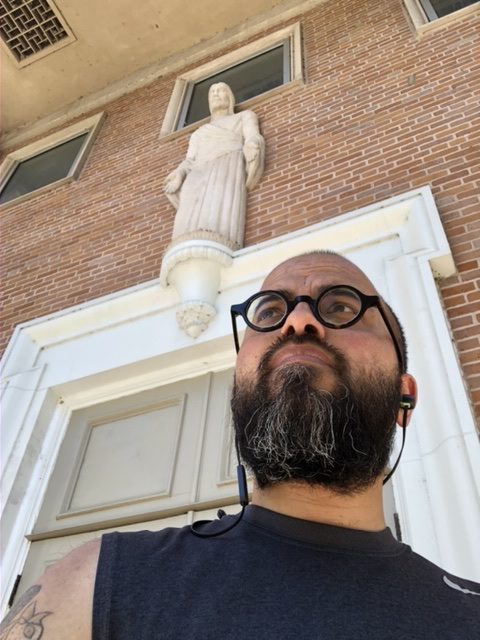
Abbey Church at St. Joseph’s Abbey in Benedict, Louisiana

I’ve been to mass many times. Parishioner’s family funeral, weddings, and the occasional ”stop” to worship. I love the worship rhythms of this ancient tradition, its sensuality, earthiness, and aesthetic. I love how those around me know by heart the movements, gestures, and words. I love how you can “sneak in” and still feel part of what is happening, even if you don’t know the choreography.

I am not saying that it is perfect. Sitting in Mass reminded me how thankful I am that our tradition includes women as leaders. I also longed to partake of the Eucharist alongside my brothers and sisters. For the un-initiated it could be intimidating: with its movement, responses, and gesturing. And there are a series of other important theological differences that make Wesleyan Christianity my home.

In the end I’ll have to say that from the moment I entered the space — with its smell of incense, the baptismal waters, the gathered community kneeling as they prayed — I began to be transported into God’s presence.

I wish those of us in the protestant tradition would lean more towards this kind of kinetic aesthetic. I think at times we are too “chatty,” explaining too much, acknowledging too much, and moving too fast. We leave little room for silence and we certainly struggle with using our bodies.

It is our bodies that open the door for the holy to shape us into a sanctified people. It is our bodies that move us into a life of discipleship. Theologian James K.A. Smith tells us:

[P]ractices — communal, embodied rhythms, rituals, and routines that over time quietly and unconsciously prime and shape our desires and most fundamental longings.

We need these movements, silence, and common language to fully experience God’s transformative presence. Our ministry of hospitality should extend in worship as we “teach” each other what it means to worship in this place, at this time.

Our Christian tradition is rich with ritual, movement, and embodied practices. Our Wesleyan heritage is rooted in an experienced grace, through sacrament, through looking over one another in love, through study and reflection on God’s word, and through worship on the Lord’s Day.

My prayer is that we find ways to move, to bow, to kneel, to raise our hands, to pray together, to hear God in the silence, to allow the smells and sounds to call our bodies to a posture of prayer. Our bodies becoming visible temples of the Holy Spirit.

Callers on the Journey

The focus of pastoral leadership is on the people because all Christians, not church leaders as such, are the primary ministers of the gospel. It is the church as a whole that is God’s “chosen race, royal priesthood, and holy nation” (2 Pet. 2:9). Pastoral leaders serve to build up the body of Christ, so that the entire church can bring the gospel of Jesus Christ to a very broken world.

Christopher A. Beeley in Leading God’s People: Wisdom from the Early Church for Today 

I was blessed with a childhood church that was fruitful, alive, and making a difference. Worship was vibrant, exciting, and God’s Spirit was palpable. In Sunday School, VBS, and other formational gatherings we learned the story through bible drills, songs, and drama. Our times of fellowship were filled with music, food, and a genuine sense of what it meant to be a community. Our mission was rooted in the neighborhood that we lived in with a clear understanding that there was also a larger world in need of Jesus Christ.

Image

Me in Cannon Chapel at Emory University – A “place” that still calls me to this journey!

This is not to say that it was perfect. As the “son of the pastor” I knew well the struggles of what it meant to lead into that kind of community. But I would say that it was that community and my father, their pastor, who first “called.”

Dad called ministry “out of me” in the ways that he lived his own pastoral life. In his commitment to leading God centered worship with integrity & passion. His hunger to help the congregation and the community find healing, wholeness, and love. He “called me” by taking me with him when he did his visitation rounds or went to help someone in need.

He modeled a “way” of being “pastor” that still guides my way today.

When dad’s ministry brought us from Puerto Rico to Louisiana I was blessed to find others who continued “calling.” My now father-in-law Ron Perry, helped shape me in the importance of discipleship, prayer, and ministering to those who could easily be forgotten. He gave me opportunities to preach, teach, and lead. He too believed that at its core pastoral leadership is about “building the body.”

In college when I was ready to leave God and the church behind dad again reminded me of my call. I needed desperately to be reminded and dad’s “contact” with a United Methodist pastor began to shape the final stages of my “surrender” to this vocation.

Don Ross taught me to persevere, to lean on God’s love, and to be a humble servant to God’s people. He called me to gifts I did not know I had, and if he would not have “pushed” me to preach and called that a gift in my life, I would probably be a professor now, not a pastor.

At the time it seemed like I had enough “calling” and I had said yes! But God had other companions in my journey of faith to continue “calling:” Donn Ann Weber who believed I had the gifts to pastor the “real church” with its struggles, challenges, and possibility; Don Saliers, Barbara Day Miller, Steffen Losel, Tom Long, Tom Frank & Gail O’Day who were more than “seminary professors” but truly challenged me and called out of me this pastoral life through their example, questions, and teaching; Francey Hooton, Carole Cotton Winn, John Williams, Craig Gilliam, and my peers in my ordination process who continued shaping my call through their witness, counsel, and patience; Kami & Casey Scarbrock, Larabee and Patrick Thompson, and Heather and Danny Smith, who have been with me for over a decade and have put up with the early bumps on the journey; and Garett Thompson, who in joining the communion of saints, kept me on the right path.

God is still calling me. In fact he calls me each and everyday to this way of life, to this service to the church, to this “building up of the body.” I live out this journey with key partners in this covenant life: my wife Shannon who reminds me everyday of what it means to love, my brother Josh Hale who still pushes me to be a pastoral theologian, Sarah Shoup, Katie McKay Simpson, Donnie Wilkinson, Brady Whitton, Leslie Stephens, and Stephen Fife who are faithful covenant partners, friends, and “guides” in my continued journey.

This fall at Exploration 2013 we are gathering in Denver to discern. God has been calling all along and has given you partners in the journey. As you hear their voices know that it is God who is using them to call you to communal discerment through communal life. If those witnesses see gifts of “building up the body” in you, join us this November as we continue hearing God “calling us on the journey.”

Reading, Writing, & Listening

The aim of church leaders should be to balance active ministry and compassion for our neighbors with prayer and a life of study and contemplation, so that our hearts dwell constantly with God and at the same time are mindful of the needs of others.

Christopher A. Beeley in Leading God’s People: Wisdom from the Early Church for Today

2012-10-20 13.21.14I have heard it again and again. At the core of pastoral life is a life of prayer, study, solitude, and active listening. These are key postures of the Christian life, of our discipleship. If pastoral leaders are to lead the Christian community into a deeper relationship to God and neighbor, then it makes sense that we are leading the way by example.

Life happens though. Our plates get filled up with meetings, “emergencies,” and general “busyness.” I am not sure what my “busyness” was exactly in 2012 but I found myself in busy mode often. Then there are our other responsibilities in our home and in relationships, the “stuff of life.”

Some years ago I wrote a short New Year’s post called The Yearly Examen. There I called on all of us to look back at the year as part of our “examination of life” and begin to see the places and times where God seemed fully present and the places and times where God seemed absent. It has been an exercise that has produced much fruit in my life through the years.

This year as I began this exercise some weeks ago I began to notice a hunger in my soul for more prayer, more study, more contemplation. I recognize how little writing I had done outside of my weekly sermons and church communication, how little reading I had done outside of the “required” stuff, how little listening I had done in meetings, gatherings, and in daily life.

Now that I knew the places where I could shine a light on God’s work in me I had to do something about it. These are not resolutions, these are goals for the year. I am thankful that I have found some companions to share this journey with in 2013.

With my brother Joshua Hale (@expatminister) I plan to read four books this year and blog some reflections on them at Liturgical Nerds. We are beginning with Love’s Immensity: Mystics on the Endless Life by Scott Cairns, followed by  Isabel Best’s The Collected Sermons of Dietrich Bonhoeffer, D. Stephen Long’s Keeping Faith: An Ecumenical Commentary on the Articles of Religion and Confession of Faith of The United Methodist Church, and James K.A. Smith’s Imagining the Kingdom: How Worship Works. I look forward to this journey with Josh as we read, write, and listen to what God is up to in us through these texts.

On January 2011 I embarked on a Bible in 90 journey that included daily blogging on the portion of scripture that spoke to me that day. This year I embark again on a Bible in 90 adventure but this time I do so with a group of friends and colleagues. Some of us will probably post some reflections along the way. Reading the bible in this way has given me a renewed appreciation for the great narrative of scripture.

I am sure that along the way I’ll find a few more books to read, reflections to write, and conversations to listen to. My prayer is to be fully present to what God’s up to in my life and in the life of the congregation by prioritizing the life of study and contemplation that is at the core of pastoral life.

Thank you for being part of the journey!

On Thirty-Four

2012 06 18 13 53 41

Here I am in one of my favorite places Cannon Chapel at Emory University.

Age is such a relative thing. I am older than some, younger than others. There is a continuum and in that continuum we have the opportunity to come together. As a leader of a faith community it is interesting how often my “age” is part of the conversation. At first I was apologetic, then curious, now I am just amused. At 34 I acknowledge my “youth” compared to the average age of my congregants, while at the same time claiming my “adulthood” in life and in faith.

Part of growing up is the recognition that we are always growing in wisdom and love. In the life of faith we call it “sanctification,” growing in God’s love. No matter how “old” we are God is still at work in us, shaping us, calling us, and challenging us. This process is best lived in a diverse community, where people can live life together and learn from one another. The church is one of the places in our society where we can gather accross the generational spectrum and learn what it means to live life together.

In my life I have been blessed to have learned from the wisdom of many. Children have taught me to be silly, playful, and not so heady about God. Older parents help me become a better father and husband, college students have helped me reconnect with my passion for a renewed church and a 97 year old helped me form my pastoral identity by being thankful that her “pastor” came to visit.

Then there is the wisdom learned from life togehter with those you love the most. I am thankful for the opportunity to be a husband, father, brother, and pastor. In this last year I have become increasingly aware of how blessed I am to be living the life that I live. I am thankful for a faithful partner in Shannon, for the joy that our three children bring us, for the support and love of my sister, and for the great honor to be a leader among the baptized. All of these roles have deeply shaped me and will continue to shape me in the years ahead.

In a recent conversation with a church member my age came up again (it seems to come up often). I guess there’s the perception that youthful appearance (or youthfulness) means a lack of experience in life and faith. I heard carefully and responded that the one promise that I could make was that I was getting older everyday. The person laughed and we were both able to walk away better aquainted with one another.

I am blessed to be “getting older” in a community of family and faith. All of us helping one another grow in love of God and neighbor, all of us learning and growing from each other, all of us worshipping, praying, and serving together. All of us with different ages, personalities, and cultural backgrounds. All of us making a mosaic of the baptized in this community.

I doubt that 34 will make a difference to those who still see me as “young.” I have thankfully been blessed with the “youthful look gene” of my mother’s family. What I do know is that I will continue my work, will continue ministering, will continue leading, and I am sure that one day I will walk down the halls of the church and someone will tell me that we need a more youthful pastor  . . .

Here’s to 34 years and to many more!